



In place of traditional welding, two-component epoxy or acrylic adhesives are dispensed to bond body panels such as roofs, hoods, and side frames. Adhesive bonding enables the use of thinner or mixed materials (aluminum, composites, high-strength steel), reducing overall vehicle weight without compromising strength. Unlike spot welding, bonding also distribute stresses more evenly than rivets or screws, improving durability and crash performance.
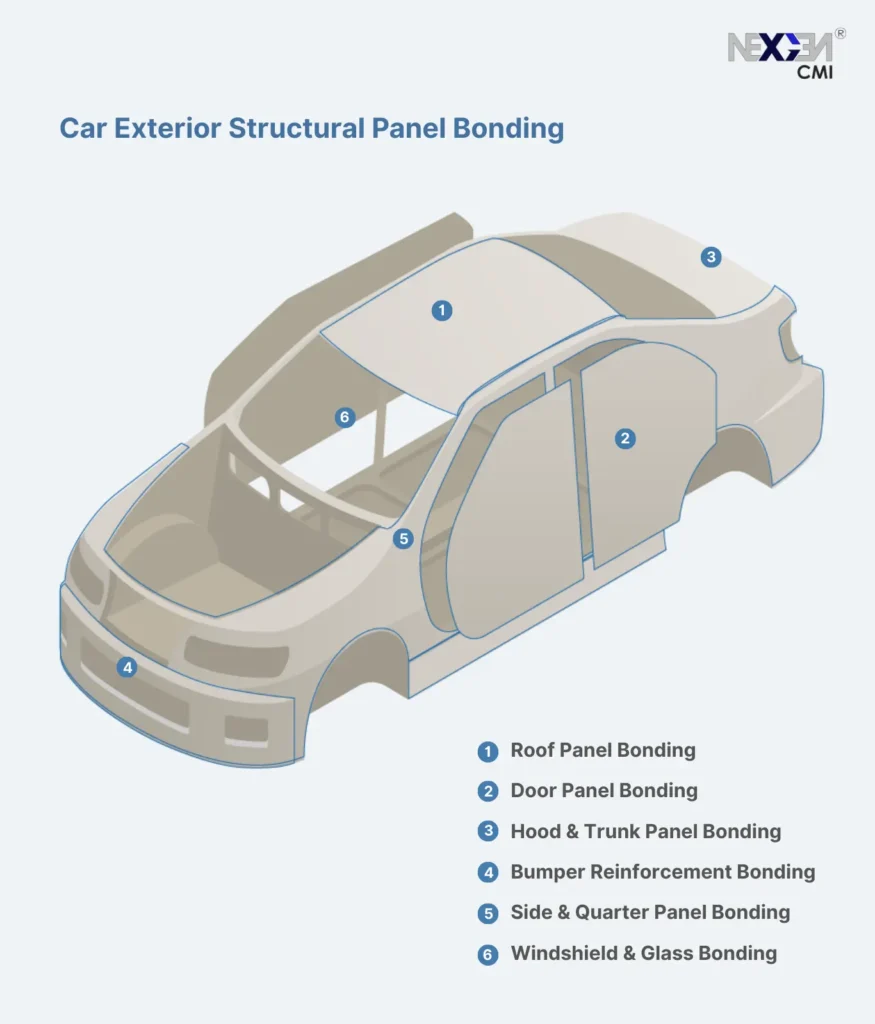
Key automotive structural bonding application areas
| Application | Description | Typical Material |
|---|---|---|
| Roof Panel Bonding | Bonds the roof panel to side frames or reinforcement beams, improving stiffness and reducing weld spots. | 2K Epoxy / Acrylic Adhesive |
| Door Panel Bonding | Bonds inner and outer door shells before hemming, ensuring vibration resistance and sealing. | 2K Epoxy / PUR |
| Hood & Trunk Panel Bonding | Replaces mechanical fasteners for lightweight metal or composite hoods/trunks. | 2K Epoxy / Acrylic |
| Bumper Reinforcement Bonding | Bonds metal/plastic reinforcement beam to the bumper fascia. | Structural Adhesive |
| Side Panel & Quarter Panel Bonding | Ensures rigidity and crash durability of large body assemblies. | Structural Epoxy |
| Windshield & Glass Bonding | Bonds windshield and fixed glass to the body frame, providing structural strength, body stiffness, and long-term waterproof sealing. | 1K / 2K PU / Silicone Adhesive |
Materials used in automotive structural bonding
Typical adhesive materials for structural panel bonding include:
- Epoxy structural adhesives (1K/2K) – high strength, excellent metal adhesion, and heat-curing capability for paint-shop compatibility.
- Polyurethane adhesives – provide flexibility and impact resistance, suitable for mixed-material joints.
- Acrylic adhesives – fast-curing options ideal for high-throughput body assembly lines.
- Silicone-modified adhesives – enhance corrosion resistance and durability under thermal cycling.
Many of these materials are thixotropic—viscous enough to hold shape but capable of flowing under dispensing pressure—making precise process control essential. However, handling these materials consistently requires precise meter-mix and dispensing control to manage viscosity variations, prevent air entrapment, and maintain uniform bead geometry throughout the bonding process.
Structural Adhesive Dispensing Requirements & Challenges
Structural panel bonding demands high-precision dispensing performance, as adhesive consistency directly impacts joint strength and dimensional quality. Key dispensing requirements include:
- Accurate ratio mixing (A:B): Two-component structural adhesives (such as 2K epoxy or polyurethane) must be mixed at the correct ratio to ensure optimal curing and bond strength. Even minor deviations can lead to incomplete curing or weak joints.
- Controlled bead geometry: Uniform bead width and height are essential for full contact across large exterior panels. Automated systems must synchronize motion control and valve timing to maintain consistent bead geometry throughout complex contours.
- Temperature-stable flow: Viscosity of structural adhesives can fluctuate with temperature. Stable temperature control during storage and application ensures consistent flow, prevents air entrapment, and maintains repeatable dosing performance.
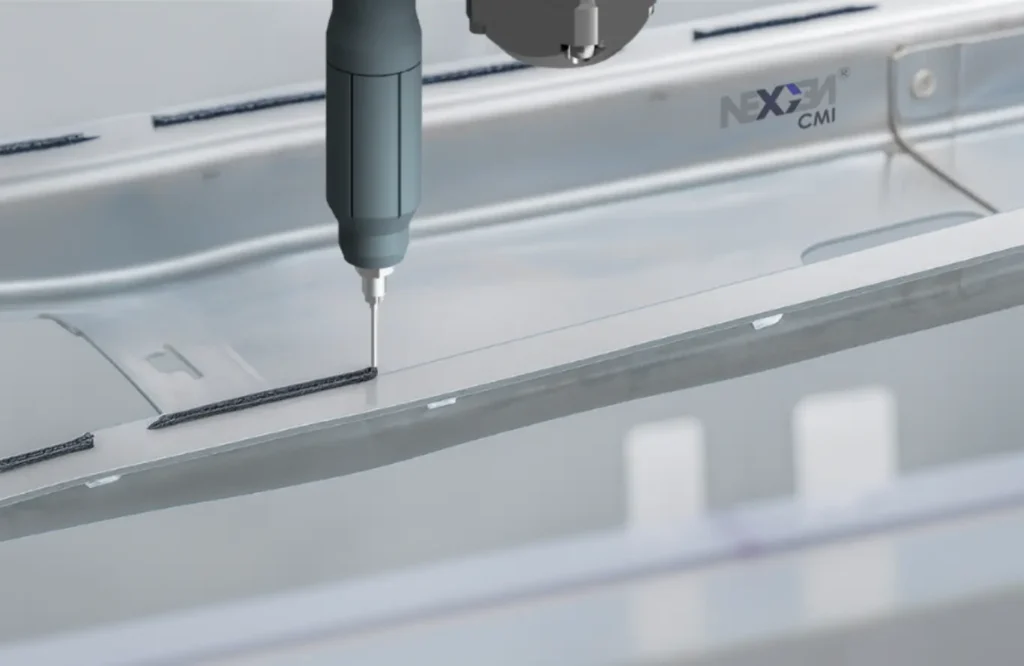
NEXGEN CMI’s high-precision meter-mix and dispensing systems deliver accurate ratio control, consistent volume output, and bubble-free bonding performance for aluminum and composite panel assemblies. Reach out to our team to explore the right solution for your application.
Structural Bonding System Consultation