




LED lighting systems are now used everywhere—from outdoor streetlights and automotive lamps to architectural fixtures and industrial luminaires. These lighting units often operate in harsh outdoor environments, exposed to dust, moisture, and temperature fluctuations. To ensure reliability and maintain optical performance, LED housings must be sealed effectively. Gasketing — the process of forming a continuous seal between enclosure parts — plays a vital role in achieving waterproof and dustproof protection (typically IP65 to IP68 ratings).
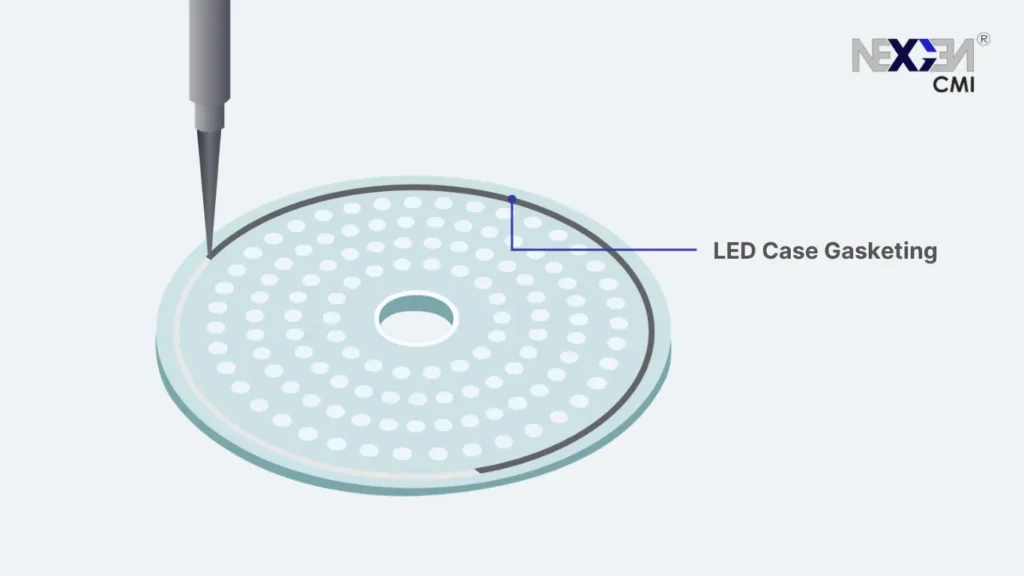
Common Gasketing Applications in LED Lighting
Unlike traditional lamps, LED fixtures contain sensitive electronics, lenses, and reflectors that are easily degraded by moisture or contaminants. Gasketing prevents water ingress, protects against corrosion, and stabilizes internal conditions to prolong LED lifespan. Automated gasketing is widely applied throughout LED manufacturing, including:





Sealing Application for LED Casing
Dispensed gaskets are often created using CIPG (Cured-in-Place Gasket) or FIPG (Formed-in-Place Gasket) technology, where liquid material is precisely applied along the groove and cured to form a permanent seal — eliminating the need for manual O-ring placement and reducing assembly time.
The most common materials used for LED housing gaskets are silicone, polyurethane foam, and EPDM rubber (along with related elastomers like neoprene). Gasketing materials are usually viscous and thixotropic, requiring precise control during application to ensure a continuous, uniform bead.
When implementing gaskets via dispensing on LED housings, manufacturers face several process challenges. The dispensed gasket must have a consistent cross-sectional profile all along its length. Variations in bead width or height can cause weak points in the seal. Consistency can be affected by equipment factors such as dispensing pressure fluctuations, or material factors like viscosity changes. For instance, as a dispensing pump cycles or as material viscosities shift with temperature, the output bead size can vary. Corners and joints are particularly tricky – slowing down in corners can deposit excess material, whereas speeding up might thin the bead. Maintaining a continuous, even bead requires a well-tuned dispensing system with closed-loop flow control.
Additionally, implementing a gasket dispensing process in a production environment must account for automation integration. This includes the physical integration (robots or gantry systems that move the dispense head around the part, or moving the part under a fixed dispenser), as well as the control integration (communication with PLCs, sensors, and possibly a vision system).
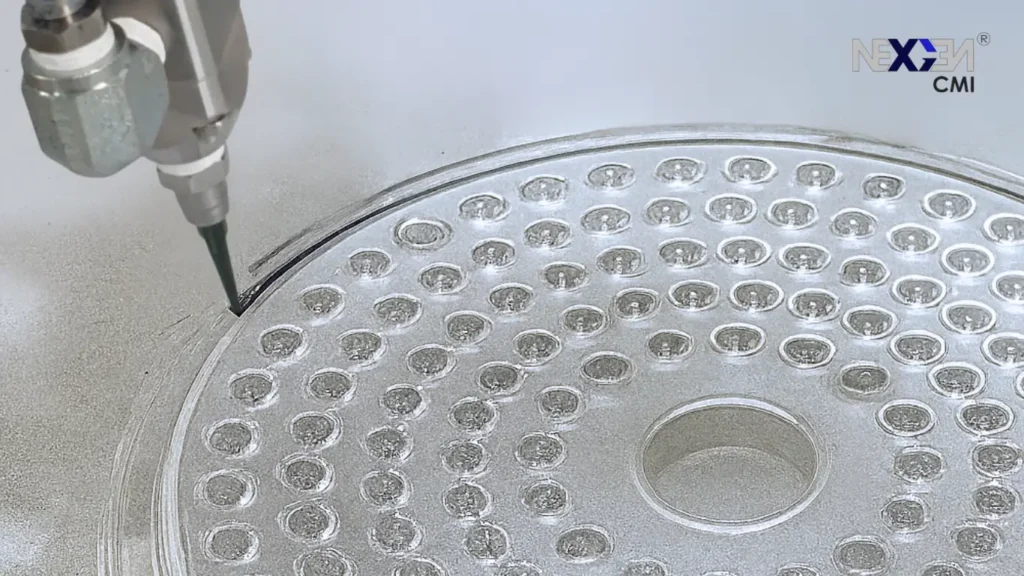
These challenges requires careful engineering and the right equipment to overcome. This is where NEXGEN come in – to provide systems that maintain precision, ensure adhesion, control curing, and seamlessly integrate into production to consistently produce high-quality gaskets. With years of expertise in adhesive dispensing and automation, we takes a customized engineering approach to meet each client’s specific needs. Contact our expert now for technical consultation!
Housing Gasketing System Consultation