


Conformal coating is a thin protective film applied to a PCB to guard it against environmental stress without adding significant bulk. Conformal coating shields the electronics from moisture, dust, chemicals, and corrosion by creating a barrier over circuitry. Conformal coating is a lightweight, surface-level protection: typically only 25–250 microns (0.001–0.010 inches) thick. The coating’s negligible weight and thickness make it ideal for size- or weight-sensitive electronics where potting would be impractical.
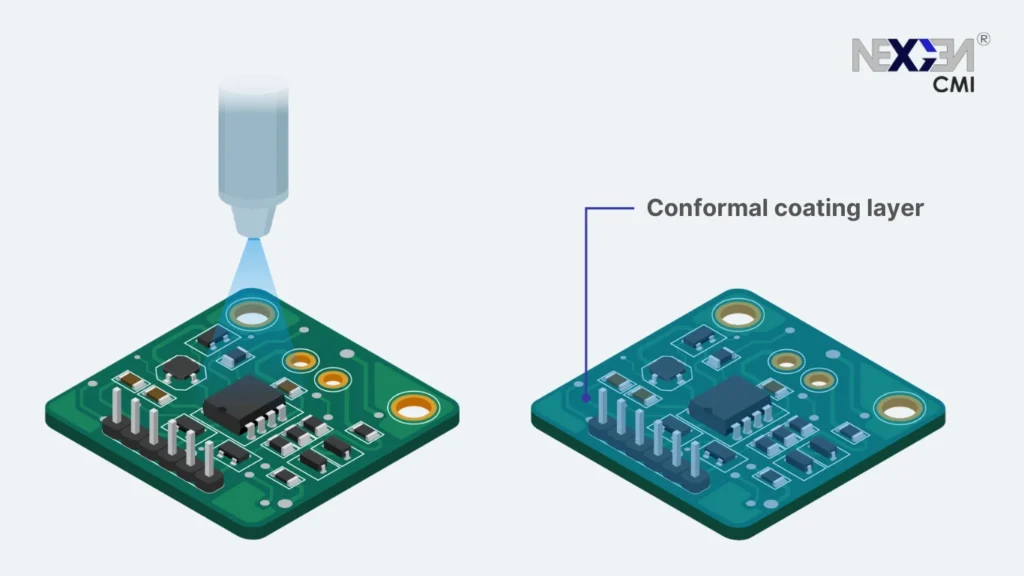
Common conformal coating materials include acrylic resins, polyurethane resins, silicone polymers, and epoxy coatings. These are usually one-component liquids that cure by solvent evaporation, moisture exposure, or UV light. Regardless of chemistry, the goal is the same: a uniform, thin insulating film over all desired surfaces of the board.
Applying conformal coatings uniformly and efficiently poses several challenges:
- Achieving uniform coverage: It can be difficult to coat an entire assembly evenly, given the mix of flat areas, vertical component leads, connectors, and crevices on a populated PCB. Liquid coating tends to run and accumulate due to gravity and surface tension. As a result, certain areas can end up with thinner or thicker coating than intended. Traditional methods like dip coating or manual spraying often show this effect.
- Material handling and consistency: Conformal coatings can be low-viscosity (some are as thin as water or alcohol) and may contain solvents. They evaporate and cure over time, which means the dispensing equipment must prevent drying or clogging in nozzles between uses. If the coating is moisture-sensitive (like moisture-cure silicone or urethane), exposure to air in the reservoir can start curing it. Thus, dispensing systems often need sealed fluid lines, agitation, or even nitrogen purge to keep the coating in optimal condition.
NEXGEN CMI addresses conformal coating challenges with programmable coating systems that combine precision and efficiency. The optimized fluid handling means the PCB is thoroughly protected by an even, insulating layer, and the process is efficient with little rework or waste. Sensitive components remain uncoated as required, and the final assemblies can withstand moisture, contaminants, and harsh service conditions with confidence. Contact us for expert consultation!
Coating system consultation