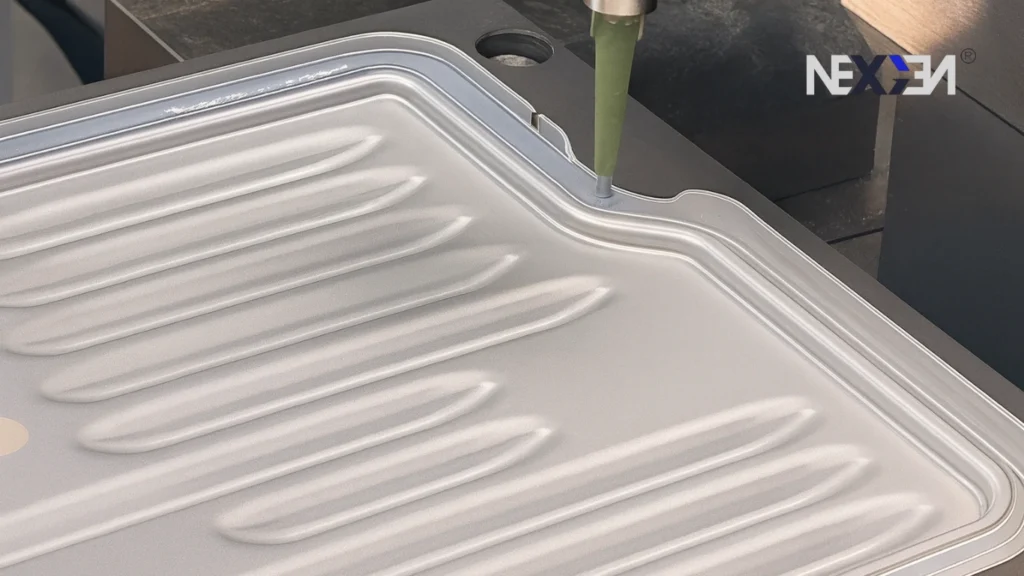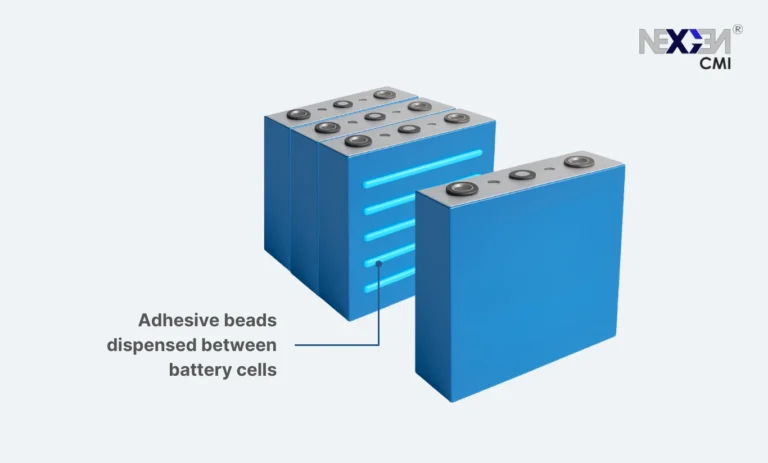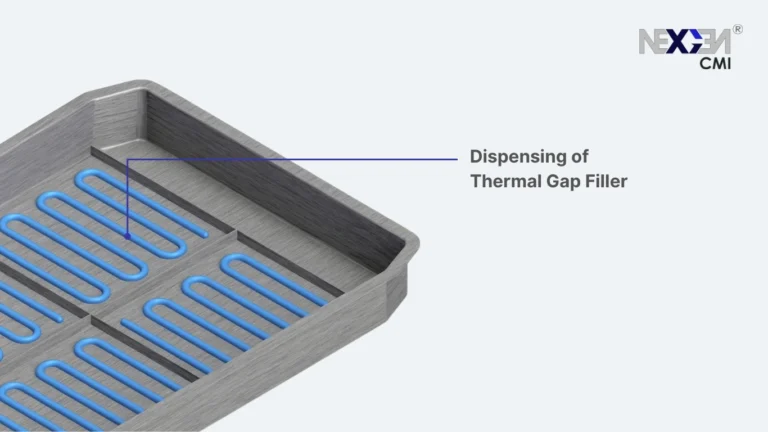




This process seals the joints and seams of battery housings to protect modules from moisture, dust, and corrosive contaminants. A continuous gasket bead around the pack’s perimeter ensures compliance with IP-rated protection standards, prevents electrolyte leakage, and helps contain potential off-gassing within the enclosure.
In this application, a uniform bead is dispensed along the mating edges of the battery tray, cover flanges, and lid seams to form a reliable barrier against water ingress and environmental exposure.
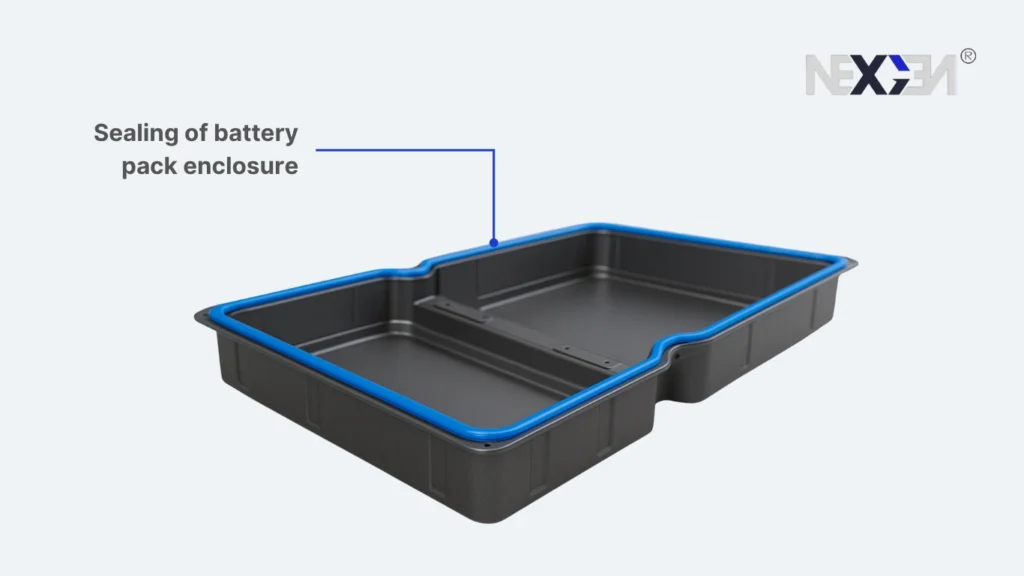
One- or two-component sealants such as silicone, polyurethane, or hybrid MS-polymer are commonly used, applied as Form-in-Place (FIPG) or Cure-in-Place (CIPG) gaskets. In some cases, hot-melt butyl materials are also used for cover sealing applications. These materials require precise metering and positioning to maintain gasket continuity and dimensional accuracy.
The bead must be continuous, uniform, and void-free, with accurate control of height, width, and start-stop points. Dispensing systems require robotic motion control to trace complex perimeter paths and real-time flow monitoring to maintain consistent volume. Mix-ratio control is essential for 2K materials, and automatic start-stop regulation prevents material stringing or overlap. NEXGEN CMI’s metering & dispensing systems provide precise volume control and consistent flow for seamless gasket formation. Compatible with both CIPG and FIPG processes, our systems deliver the repeatability and accuracy needed to meet stringent leak-test and durability requirements.