



This process securely aligns and bonds individual battery cells, creating a rigid module structure that resists vibration and evenly distributes mechanical loads. The adhesive layer also acts as a thermal bridge to transfer heat between cells while maintaining reliable electrical insulation.
In this application, beads of adhesive are dispensed between adjacent cells, as well as along cell stacks, sidewalls, and crossmembers.
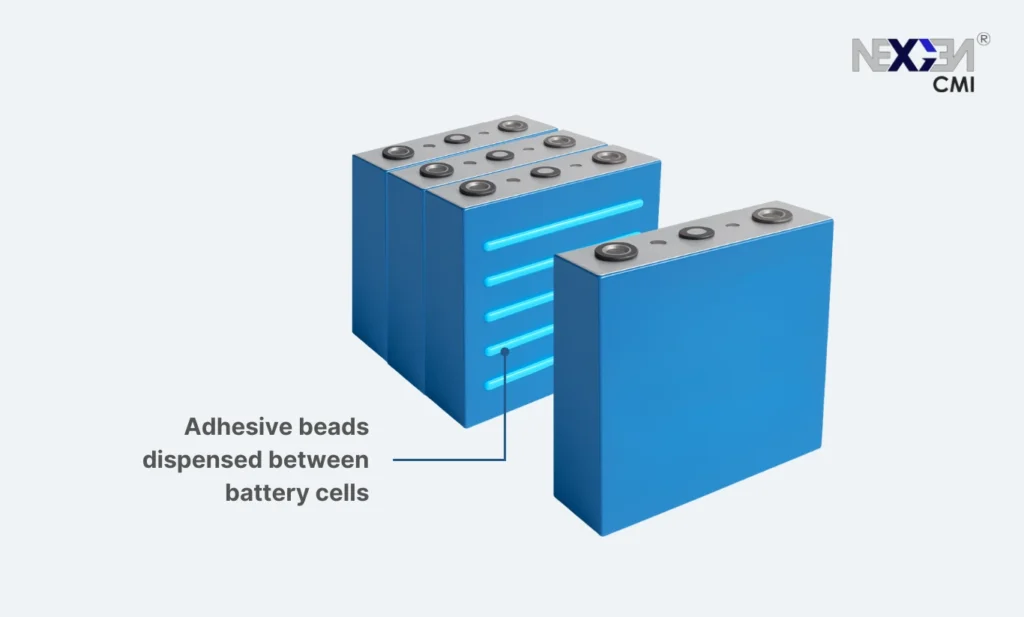
Two-component (2K) structural adhesives (typically epoxy or polyurethane formulations) are commonly used for cell-to-cell bonding. Some variants are thermally conductive to facilitate heat dissipation between cells. These materials combine high mechanical strength with moderate flexibility, allowing them to absorb vibration and accommodate slight dimensional changes. However, their medium-to-high viscosity and sensitivity to mixing ratio present challenges in achieving uniform flow and consistent curing.
Precise control of bead thickness, placement, and mix quality is essential. Dispensing systems must avoid air entrapment that could weaken the bond or disrupt heat transfer. Because external heat or pressure cannot be applied to battery cells, 2K or room-temperature curing adhesives are preferred, and bead geometry must account for potential cell expansion. NEXGEN CMI’s automated 2K dispensing systems maintain accurate ratio control and stable flow to ensure void-free, homogeneously mixed material and precise bead placement.